Collagen is one of the central structural proteins of the extracellular matrix. It gives tissues such as tendon, bone, skin, cartilage, and ligament much of their mechanical strength, and it plays a major role in wound healing, fibrosis, tissue engineering, and biomaterials design. In many disease and development contexts, collagen is not just present as a passive scaffold — its organization, cross-linking, hydration, stiffness, and failure behavior influence how cells sense and remodel their environment.
That makes collagen scientifically important, but also difficult to study. Molecular simulation can connect scales and make mechanisms visible in a way that is difficult to access experimentally. The challenge is that collagen and ECM simulations are rarely simple to reproduce or extend. The scientific question may be clear, but the workflow can be fragile.
Why Collagen Is Hard to Simulate Reproducibly
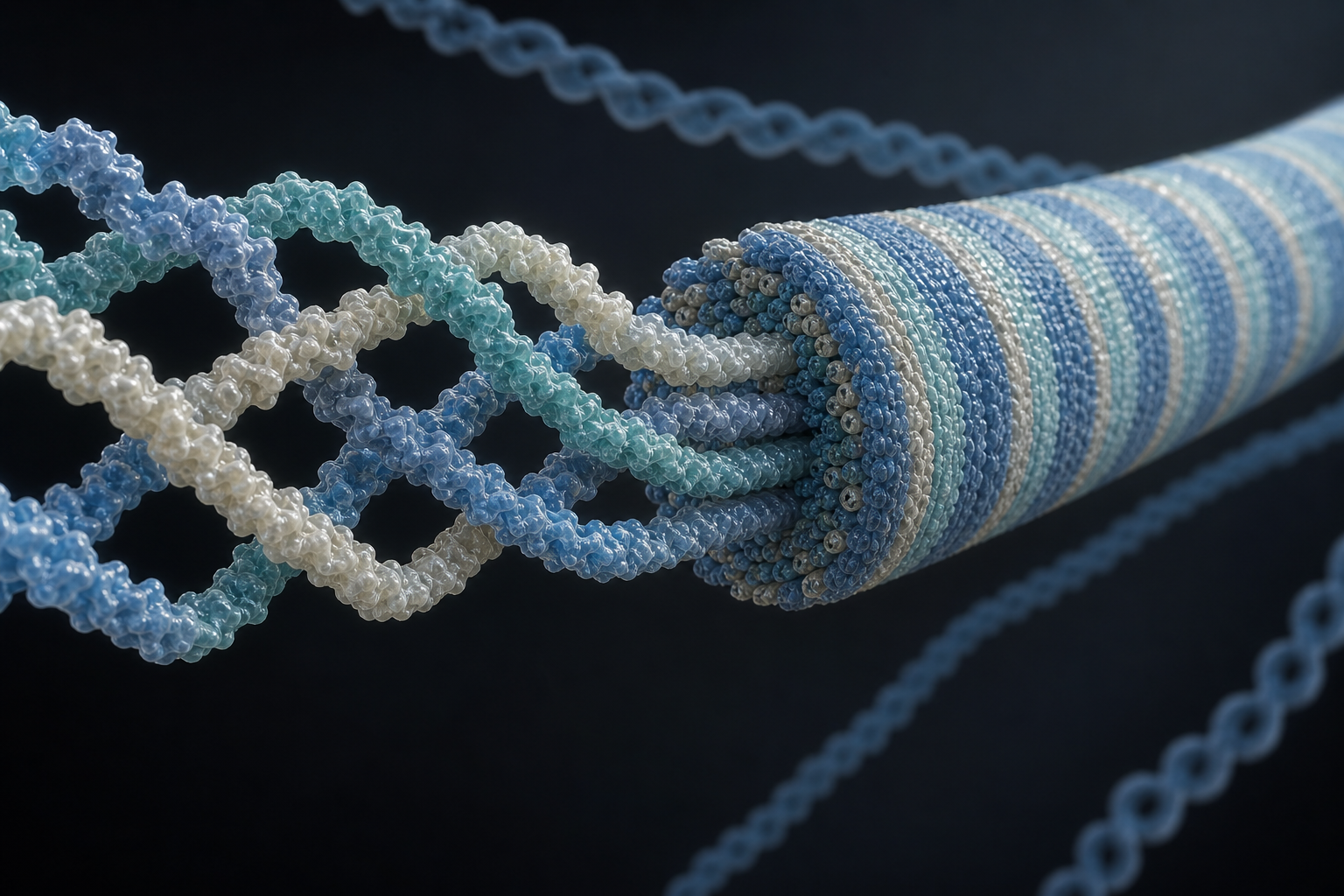
Experimentally, collagen is hierarchical. A single collagen molecule forms a triple helix. Triple helices assemble into fibrils. Fibrils form fibers and tissue-scale networks. Mechanical behavior at the tissue level depends on events that occur across many scales: molecular stretching, cross-link deformation, fibril sliding, hydration, and rupture. Many of these processes are difficult to isolate in the lab because collagen structure is heterogeneous, cross-link chemistry varies with age and disease, and mechanical loading changes the structure while it is being measured.
Simulation is useful because it can control each of these variables independently. But that control comes with a cost: the workflow itself becomes complex, and a small mismatch in any layer can silently invalidate the result.
Rebuilding the 67 nm Collagen Fibril Workflow
We recently rebuilt a workflow around the 67 nm collagen fibril simulations from the Martini 3 collagen fibril model developed by Brosz, Buck, Gräter, and colleagues. The 67 nm length is biologically meaningful because it corresponds to one collagen D-band — the repeating gap/overlap unit seen in fibrillar collagen. The paper develops a Martini 3 coarse-grained model for collagen fibrils with divalent and trivalent cross-links, validated against all-atom simulations and experimental observables.
The scale mattered because large collagen systems amplify reproducibility risk. In an all-atom preparation route, the solvated fibril can reach more than 3 million atoms. At that point, reproducibility depends on many coupled layers: structure format, topology, cross-link definitions, software versions, GROMACS input files, ColBuilder behavior, solvation, ionization, equilibration, and pull-group definitions. A small mismatch in any layer can stop the workflow — or, worse, produce a simulation that runs but measures the wrong experiment.
What Published Data Does and Doesn't Give You
Published datasets are an important starting point. They often include structures, topologies, parameter files, checkpoints, and trajectories. But for complex collagen simulations, those files do not always form a complete, directly reusable workflow in a new environment.
In this case, some deposited runs could be continued from checkpoints. Other parts required missing
GROMACS .tpr files to be rebuilt. Some pull index files were missing and had to be
reconstructed. The trivalent all-atom fibril required topology repair before it could be prepared as a
complete simulation system.
That distinction matters. A coordinate file tells you where atoms or beads are. A topology describes the chemistry and bonded structure. An index file defines the groups used for pulling, restraints, or analysis. A compiled GROMACS input file combines these pieces into the actual runnable simulation. For a collagen fibril, those pieces are tightly coupled — and reproducibility is a question of whether they still describe the same physical system when the workflow is rebuilt.
The Gō Model: Preserving Collagen Structure in Martini 3
The Martini 3 collagen model is especially interesting because it combines coarse-grained efficiency with additional structure-preserving information. In standard Martini 3, each bead represents a small group of atoms — that makes larger systems accessible, but collagen has a demanding geometry: the triple helix must remain stable while the fibril is stretched.
The paper addresses this using a Gō model, applied through virtual sites associated with the protein backbone beads. In practical terms, the Gō model helps preserve the native triple-helical architecture that standard Martini 3 does not automatically maintain. This allows residue-level coarse-grained structure to be retained while reaching larger fibrillar systems. An important nuance: under high pulling forces, the mechanical response depends strongly on the fitted bonded parameters, especially backbone bond stiffness. The Gō model maintains the fold, but force response under load still requires careful parameterization and validation.
That combination is powerful, but it also increases workflow complexity. The system is no longer a generic protein simulation — it is a collagen-specific, cross-linked, structure-biased, mechanically loaded model.
The Hidden Risk: A Simulation Can Run and Still Be Wrong
One of the most important lessons from the reproduction was the pull-index failure mode.
For constant-force pulling simulations, the index file defines where the force is applied. In the paper's protocol, each pulling group corresponds to the terminal caps of an individual triple helix, so force is applied to the intended collagen molecules along the fibril axis.
When the missing pull index was reconstructed, an early version produced group names that matched the GROMACS input file, but the group membership was wrong. From a software perspective, the setup could compile. From a physics perspective, the pulling experiment was incorrect: force was applied to only part of the fibril rather than to the intended set of triple helices.
Key Takeaway
The failure was not obvious. The trajectory existed, the output files looked normal — but the result was physically misleading. For collagen mechanics, this is especially consequential because the biological interpretation depends on exactly where load is applied and how it is transmitted through the fibril. A wrong pull group can change the apparent extension, strain distribution, and mechanical response.
Topology and Equilibration Are Part of the Science
The trivalent all-atom fibril showed another common failure mode: incomplete topology. The deposited structure existed, but several molecule topology files were incomplete or empty. Before the fibril could be solvated, ionized, minimized, equilibrated, or pulled, the missing topology content had to be regenerated — requiring the structure to be prepared in a form ColBuilder could interpret, and compatibility issues between ColBuilder and newer GROMACS output conventions to be patched.
This kind of problem is common in collagen and ECM workflows. The structure may look correct in a molecular viewer, but the topology may not describe the chemistry needed for simulation. For cross-linked collagen, that gap is critical because the mechanical response depends on covalent connectivity.
Solvation and equilibration also required judgment. The all-atom fibril needed realistic boxing, water placement, ionization, minimization, NVT and NPT equilibration, and validation before pulling. Early instability was treated as a diagnostic rather than a nuisance: it pointed to setup choices that had to be corrected before production dynamics could be trusted.
"For large ECM systems, preparation steps are not routine administrative work. They define whether the final trajectory is physically interpretable."
What We Help Teams Build
At SimAtomic, we help collagen and ECM teams build, debug, and validate molecular simulation workflows. The most valuable output is not just a trajectory — it is a workflow the team can inspect, reuse, and extend.
- Custom collagen fibril setup and topology repair
- GROMACS and ColBuilder workflow debugging
- Martini 3 and all-atom system preparation
- Pull-index reconstruction and validation
- Equilibration troubleshooting and constant-force pulling setup
- Analysis-ready trajectories with reproducible documentation
For academic labs, this may mean making a published collagen model usable for a new hypothesis. For biotech teams, it may mean testing how cross-linking or ECM composition affects mechanics. For biomaterials companies, it may mean connecting molecular structure to scaffold performance. For computational groups, it may mean turning a fragile setup into a reproducible pipeline.
Large collagen and ECM simulations fail because the systems are complex: chemically, structurally, mechanically, and computationally. A good workflow makes that complexity visible, checks it layer by layer, and prevents technical artifacts from becoming scientific conclusions.
Working on a Collagen or ECM Simulation?
Whether you need topology repair, workflow reconstruction, or end-to-end setup from scratch, SimAtomic can help you build a reproducible pipeline — and trust the result.
Get in TouchReferences
- Brosz M, Buck M, Gräter F, et al. "A Martini 3 Model for Collagen Fibrils with Divalent and Trivalent Cross-Links." Journal of Chemical Theory and Computation.